
Treatment
Does losing weight weaken your bones, and what protects them?
A little bone density does come off with the weight, mostly at the hip. The size of that change, and the two things that blunt it, are both well measured.

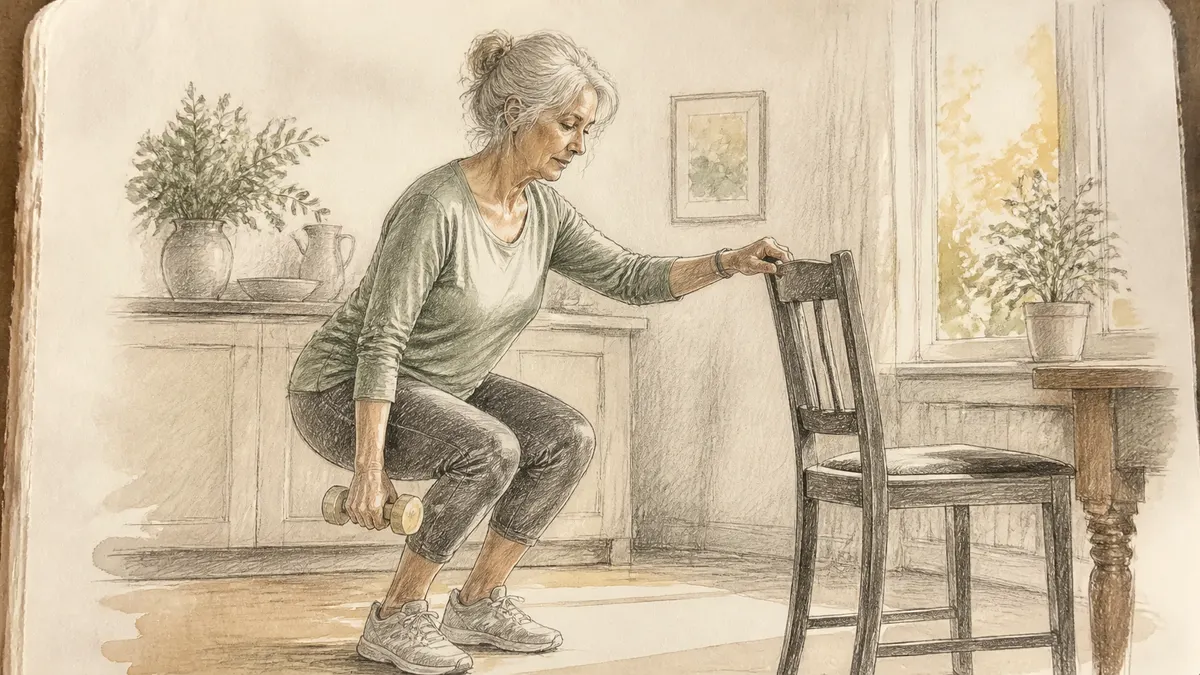
The muscle question comes up first. The bone question arrives later. It usually follows a relative's broken hip, or a frightening search result.
Bone does change. A small amount comes off, mostly at one site. Two things change how much.
Does losing weight take bone with it?
A little, and mostly at the hip. A 2015 meta-analysis in the Journal of Bone and Mineral Research pooled forty-one publications on weight loss through eating changes. The adults in them were living with overweight or obesity, and otherwise healthy. Total hip density fell slightly at six, twelve and twenty-four months. At the lower spine, nothing measurable changed. The authors put it plainly:
This decrease is small in comparison to known metabolic benefits of losing excess weight.
A small, measured shift at one site. That's all.
Why does your skeleton respond to weight loss?
Because bone is living tissue that sizes itself to its job. It's rebuilt all your life, following the load it carries. Picture a road crew that paves to the traffic count. Weight loss lowers the count and thins the supply.
- Load. A lighter body puts less force through the hip at every step, so the crew paves thinner.
- Supply. Eating less can mean less calcium absorbed and less protein arriving; in that meta-analysis, markers of bone breakdown rose early in a diet.
- Signals. A 2012 review in Annual Review of Nutrition describes hormones and cytokines acting on bone and on calcium absorption at once.
None of that is damage, and it is not a sign you went about it wrongly. It is the adaptation we described in why your body fights weight loss.
Bone follows the load you put through it and the food you bring it, not the number on the scale. So the plan that protects your muscle is the plan that protects your skeleton, and you only have to build one.
Does losing weight raise the chance of breaking a bone?
Much depends on why the weight came off. A 2015 BMJ analysis of the Women's Health Initiative followed about 120,000 postmenopausal women for eleven years on average. Women whose weight fell unintentionally had about a third more hip fractures. Women who lost weight on purpose had about fifteen per cent fewer. Among those same women, fractures of the lower limb were about a tenth more common. The authors' conclusion counts deliberate weight loss among the changes that go with a higher incidence of fracture, and says the pattern differs by site. For weight lost on purpose, that higher count is the lower limb; at the hip, the one fracture the study confirmed from medical records, the signal ran the other way.
Read that as an association, not a promise: it was a later analysis of an observational study, and the women reported their own intent. The worrying signal is weight that falls away by itself. Weight you take off deliberately, with care, is not the hazard the headline implies.
Load the skeleton, and feed it
Both, and each has its own evidence. A 2011 trial followed 107 adults aged 65 and over living with obesity for a year. Hip bone density fell about three per cent with dieting alone, and about one per cent when exercise was added. A 2017 trial in the same age range compared exercise modes during weight loss, with no diet-only arm. Hip density fell about three per cent with aerobic work, one per cent with both, and half a per cent with resistance work alone.
Feeding it counts too. Another year-long trial, from 2011, followed forty-seven postmenopausal women through a seven per cent weight loss, with calcium matched. The higher-protein diet held more bone at the hip, spine and forearm. A 2017 meta-analysis from the National Osteoporosis Foundation found moderate evidence of the same at the lower spine, and no harm from more protein. One plate serves both; the article on protecting muscle carries the protein targets.
Osteoporosis Canada's 2023 guideline covers bone health generally. It recommends balance and functional training at least twice a week, and suggests progressive resistance training at least as often.
What about medication and surgery?
Different answers. In a 2024 trial, 195 adults with obesity and without diabetes were followed for a year. Those who took liraglutide and exercised lost the most weight, about seventeen kilograms, and their hip and spine density held against placebo. At a similar weight loss, the medication alone cost more density than exercise alone: there, the exercise is what protected the bone. A 2025 meta-analysis of this family of medications did not find an increased fracture risk, in people with type 2 diabetes.
After bariatric surgery, the answer is procedure-specific. In a 2022 review, the observational data showed a higher relative risk of fracture after the operations that reduce absorption, beyond about two years. The restrictive ones showed no increase. Obesity Canada asks for calcium citrate and vitamin D, enough protein, activity, and a bone density test at two years. That follow-up belongs with your surgical center.
How we approach this at GOALS
GOALS is the obesity and lifestyle medicine program at Guelph Internal Medicine Clinic, and the medical care is covered by OHIP, by referral from your family doctor or nurse practitioner. Physical activity and strength, nutrition and objective measurement are part of that care; the first two are what the bone trials point to. Whether you need a bone density test is for you and your family doctor. A scan of muscle, fat and water isn't that test.
If you can, once a day this week, stand up out of your chair five times without using your hands. That is load, and load is the signal your skeleton listens for.
Common questions
Will my weight-loss medication weaken my bones?
Probably not by itself. In a year-long trial of adults with obesity and without diabetes, those who took liraglutide and exercised had unchanged bone density at the hip and spine, despite the largest weight loss in the trial. Taking the medication without exercising cost more density than exercising alone did. Strength work alongside the medication is what held bone in that trial; raise any bone worry with your prescriber.
Does my body-composition scan measure my bone density?
No. The scan we use shows muscle, fat and water. It doesn't measure bone strength and it doesn't estimate your fracture risk, because those are different measurements ordered for different reasons. If bone is your question, it belongs with your family doctor rather than with a scan report.
How much calcium and vitamin D do I need?
Health Canada's reference intake is a thousand milligrams of calcium a day, rising to twelve hundred for women over fifty and men over seventy, with six hundred international units of vitamin D, or eight hundred past seventy. Osteoporosis Canada's 2023 guideline, quoting Health Canada, adds a four-hundred-unit vitamin D supplement for adults over fifty, and suggests no calcium supplement when food already meets the allowance. Confirm your own targets with your physician or dietitian.
Should I ask for a bone density test?
Ask, and let your family doctor decide. Canada's 2023 guideline tests according to fracture risk rather than age or weight alone, using a fracture-risk calculator your doctor runs with your own history. When the test is insured in Ontario is best checked by whoever orders it. Your family doctor or nurse practitioner can also refer you for an OHIP-covered obesity medicine consultation.
Sources & further reading
- Zibellini J, Seimon RV, Lee CMY, et al. Journal of Bone and Mineral Research (2015). Does Diet-Induced Weight Loss Lead to Bone Loss in Overweight or Obese Adults? A Systematic Review and Meta-Analysis of Clinical Trials. Forty-one publications in adults living with overweight or obesity who were otherwise healthy. PubMed 26012544
- Crandall CJ, Yildiz VO, Wactawski-Wende J, et al. BMJ (2015). Postmenopausal weight change and incidence of fracture: post hoc findings from Women's Health Initiative Observational Study and Clinical Trials. 120,566 postmenopausal women, mean fracture follow-up eleven years; intent was self-reported. PubMed 25627698
- Shapses SA, Sukumar D. Annual Review of Nutrition (2012). Bone metabolism in obesity and weight loss. PubMed 22809104
- Villareal DT, Chode S, Parimi N, et al. New England Journal of Medicine (2011). Weight loss, exercise, or both and physical function in obese older adults. 107 adults aged 65 and over living with obesity, over one year. PubMed 21449785
- Villareal DT, Aguirre L, Gurney AB, et al. New England Journal of Medicine (2017). Aerobic or Resistance Exercise, or Both, in Dieting Obese Older Adults. 160 adults aged 65 and over living with obesity; there was no diet-only arm, so the comparisons are between exercise modes. PubMed 28514618
- Sukumar D, Ambia-Sobhan H, Zurfluh R, et al. Journal of Bone and Mineral Research (2011). Areal and volumetric bone mineral density and geometry at two levels of protein intake during caloric restriction: a randomized, controlled trial. Forty-seven postmenopausal women over one year, with calcium intake controlled at 1.2 g a day. PubMed 21611972
- Shams-White MM, Chung M, Du M, et al. American Journal of Clinical Nutrition (2017). Dietary protein and bone health: a systematic review and meta-analysis from the National Osteoporosis Foundation. Sixteen randomized trials and twenty prospective studies. PubMed 28404575
- Jensen SBK, Sørensen V, Sandsdal RM, et al. JAMA Network Open (2024). Bone Health After Exercise Alone, GLP-1 Receptor Agonist Treatment, or Combination Treatment: A Secondary Analysis of a Randomized Clinical Trial. 195 adults aged 18 to 65 with obesity and without diabetes, over 52 weeks; the medication studied was liraglutide. PubMed 38916894
- Tan Y, Liu S, Tang Q. Acta Diabetologica (2025). Effect of GLP-1 receptor agonists on bone mineral density, bone metabolism markers, and fracture risk in type 2 diabetes: a systematic review and meta-analysis. Twenty-five studies; the population is people with type 2 diabetes, not obesity without diabetes. PubMed 39985672
- Saad RK, Ghezzawi M, Habli D, et al. Osteoporosis International (2022). Fracture risk following bariatric surgery: a systematic review and meta-analysis. Four trials and fifteen observational studies; relative risks only, with no absolute fracture rates reported. PubMed 34988627
- Morin SN, Feldman S, Funnell L, et al. CMAJ (2023). Clinical practice guideline for management of osteoporosis and fracture prevention in Canada: 2023 update. Osteoporosis Canada; postmenopausal females and males aged 50 and over. It does not address weight-loss-induced bone loss. PubMed 37816527
- Health Canada. Dietary Reference Intakes reference tables: reference values for elements. The calcium figures. Read 2026-09-02, re-read 2026-11-18. canada.ca
- Health Canada. Dietary Reference Intakes reference tables: reference values for vitamins. The vitamin D figures. Read 2026-09-02, re-read 2026-11-18. canada.ca
- Shiau J, Biertho L. Obesity Canada. Canadian Adult Obesity Clinical Practice Guidelines, Bariatric Surgery: Post-Operative Management, version 1 (4 August 2020). obesitycanada.ca
This article is general health information, not personal medical advice. Please don't start or stop a supplement, or change a dose, on the strength of it; review it with your own care team. Ask your family doctor or nurse practitioner about an OHIP-covered obesity medicine consultation, and about whether a bone density test is right for you.